
The Guru yoga of Je Tsongkhapa according to the Segyu lineage was originally taught by Buddha Manjushri as part of a special scripture known as the Kadam Emanation Scripture. It was extracted from this scripture by Je Tsongkhapa himself. These days, the practice is known as Ganden Lhagyema in Tibetan, or The Hundreds of Deities of the Joyful Land in English. The name derives from the fact that in the first verse we invite Je Tsongkhapa to descend from the heart of Buddha Maitreya, who is known as the ’Protector of the hundreds of Deities of the Joyful Land’.
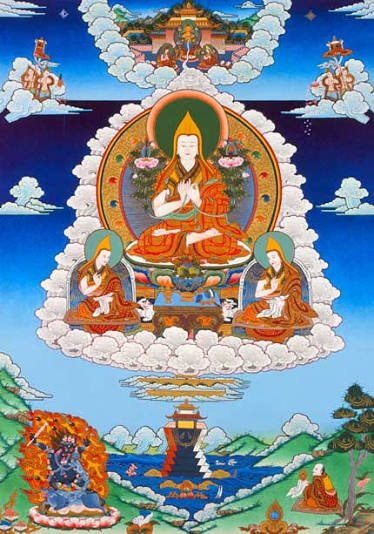
Je Tsongkhapa passed this instruction to Je Sherab Senge, who was one of his main disciples. Je Sherab Senge was born in the upper part of Tibet called Tsang. He was a very holy meditation master and scholar who had thousands of disciples, including Je Gendundrub, the first Dalai Lama.He was the holder of the lineage of the Tantric teachings of Je Tsongkhapa and, as predicted by Je Tsongkhapa, he established Gyume Tantric College in central Tibet and Segyu Tantric College in the upper part of Tibet.
Je Sherab Senge passed this instruction to Dulnagpa Palden Sangpo, who was one of his main disciples. Palden Sangpo was also born in Tsang, in a town called Tanagdo near Tashilhunpo Monastery, and he was ordained at Narthang Monastery. After receiving this instruction, he
practised it sincerely and as a result gained very high spirit-ual realizations. He was able to help many sick people by curing serious diseases and by pacifying obstacles through healing actions performed in conjunction with the Migtsema prayer.
In general, there are many people who are harmed by spirits called ’Behar’. These spirits enter into people’s bodies, causing them to become insane, interfering with their spiritual development, or causing untimely death. Once, while Palden Sangpo was engaged in a retreat on the
Migtsema prayer at a place called Sepu, a Behar spirit began to harm a rich family who lived nearby. Many of their relatives had already been killed by such spirits, and now this spirit was trying to enter into the body of the son of the family. The members of the family were very worried and they requested Palden Sangpo to stop the spirit harming their son. Palden Sangpo accepted their request and gave the father a number of beads from the mala he had used during his Migtsema recitation. He told him, ’When the spirit enters your son’s body, immediately place one bead at every exit to your house. This may cause the spirit to cry out in terror, and if this happens, call me.’ The father did exactly as Palden Sangpo had said, and in this way trapped the spirit in his house. The spirit was terrified and cried, ’I want to escape from this house but many powerful and terrifying wrathful beings are preventing me.’
The father immediately went to Palden Sangpo and requested him to come to his house. When Palden Sangpo arrived he asked the spirit, ’How can you inflict harm on many mother sentient beings when you yourself cannot bear even this slight suffering? From now on, you must not harm anyone else. If you do not promise to stop harming others, Yamantaka will not let you go.’ The spirit replied, ’I follow the orders of the chief Behar spirit. If I do not harm anyone, my powers will diminish and I will suffer. Please do not ask so much of me, please reduce the commitment.’ Palden Sangpo told the spirit, ’At least you must promise me that you will not harm anyone who recites the Ganden Lhagyema or Migtsema prayers’, and the spirit said, ’Yes, I can promise you this.’ Palden Sangpo then gathered up the beads of his mala from the exits to the house and the spirit immediately left the boy’s body and fled. The boy became normal again and did not suffer further. Later, people clearly realized that anyone who recites the Ganden Lhagyema and Migtsema prayers will be protected from harm by Behar spirits.
Both the Ganden Lhagyema and the Migtsema prayers come from the Kadam Emanation Scripture. This scripture, which is the same nature as Manjushri’s wisdom, cannot be seen by ordinary beings, and the instructions it contains are not written in ordinary letters. So that ordinary beings could see these prayers, Palden Sangpo wrote them out in ordinary letters, in the form of prose. Later, Khedrub Sangye Gyatso wrote the verses that we now recite. Je Palden Sangpo passed this instruction on to Gyuchen Gendunpai, who passed it on to Gyuchen Tashipa, who passed it on to Je Samdrub Gyatso, who passed it on to Tsondrupa, who passed it on to Dorje Sangpo, who passed it on to Khedrub Sangye Gyatso. Eventually the instruction reached Je Phabongkhapa and Kyabje Trijang Dorjechang, spiritual Father and Son. This lineage is an uncommon close lineage that comes from Buddha Shakyamuni to Manjushri, and directly from Manjushri to Je Tsongkhapa, Je Sherab Senge, and so on. Through the kindness of Je Sherab Senge, Je Palden Sangpo, and Khedrub Sangye Gyatso, this instruction flourished throughout Tibet. Since these Lamas came from the area called Se, in the region of Tashilhunpo Monastery, the lineage is called the ’Segyu lineage’.
The history and lineage instruction were written by Geshe Kelsang Gyatso in his book titled “Heart Jewel.”
The Founding of the Segyu Tantric College
While Je Sherab Sengge was residing at Sengge Tse, one day in the tea row Je Gendün Drub sat at the head of the right-hand row and Dulnagpa Palden Zangpo at the head of the left. Je Sherab Sengge asked Dulnagpa what his birth-year sign was, and he replied, “The Horse.”
“That is auspicious,” said Je Sherab Sengge. “As the worldly proverb has it, where the yak dies, the horse dances. Go, then, to Yakshi valley, and there teach and study the tantras.”
He offered Dulnagpa his own paṇḍita’s hat and brocade robe, but Dulnagpa replied, “These befit Gendün Drub. What I need is the Je’s Four Commentaries Combined.” Taking the texts, he set out for a region he did not know, asking directions as he went. At the mouth of the valley he asked a man where Yakshi valley lay. “I know no valley by that name,” the man answered. “That ravine up there is called Yakshi Nang.”
There he built a scripture-house against a rock face and trained in the generation and completion stages of Vajrabhairava. His samādhi of the two stages grew so stable that he maintained divine pride and clear appearance even between sessions; and when he walked upon the rock at those times, he was seen more than once by others in the form of a great wild yak. On the rock behind his retreat there stood a self-arisen image of Vajrabhairava. “In this valley,” people said, “there is one who emanates in the form of many monks,” and all who heard of him became devoted.
It was here too that he pacified the affliction which was then killing many in that place, as recounted above. From that time his renown grew, monks gathered around him in great numbers, and he bestowed extensive tantric teachings, transmissions and guidance. He built a temple with its sacred supports, and gave the manuscript of Je Rinpoché’s Four Commentaries Combined as the support of the assembly. The community that formed became known as Segyu (སྲད་རྒྱུད་) and Tsanggü (གཙང་རྒྱུད་) — and it continues to flourish to this day.
This is the tantric college that Je Sherab Sengge founded by entrusting it to Dulnagpa.
Afterwards Je Sherab Sengge returned to Ü. Je Gendün Drub — later known as the First Dalai Lama — escorted him as far as Tsashor, and neither master nor disciple could bear the parting before he at last turned back. Je Sherab Sengge travelled on to Ganden, where he taught the tantras extensively, and the assembly that gathered there became the Gyumé Tantric College. Segyu was thus established first, and Gyumé after it.
The Eight Great Guidances
From its founding the college devoted itself to the tantras, and above all to the eight great guidances (khrid chen gyé):
- The Five Stages of the Guhyasamāja completion stage
- Chakrasaṃvara according to Lūyipa
- Chakrasaṃvara according to Ghaṇṭapāda
- The four yogas of Vajrabhairava, in stages
- The six-branch yoga of Kālachakra
- Vajrapāṇi Mahāchakra
- The Six Yogas of Nāropa
- Phowa — Opening the Golden Door
Alongside these, the college brought to mastery a series of branch guidances: the three sixty-fold practices; the Mahākāla torma-accomplishment; the great torma guidance; the Vajrabhairava trulkhor; the Vajrabhairava fire-offering Ocean of Siddhis; and the four great averting rites beginning with White Umbrella (Sitātapatrā). For the tsog recitation, the entire seventeen chapters of the root tantra were recited in full.
These are the practices that Segyu Gaden Phodrang continues to preserve at its monastery in Kathmandu today.
The Segyu Lineage Masters
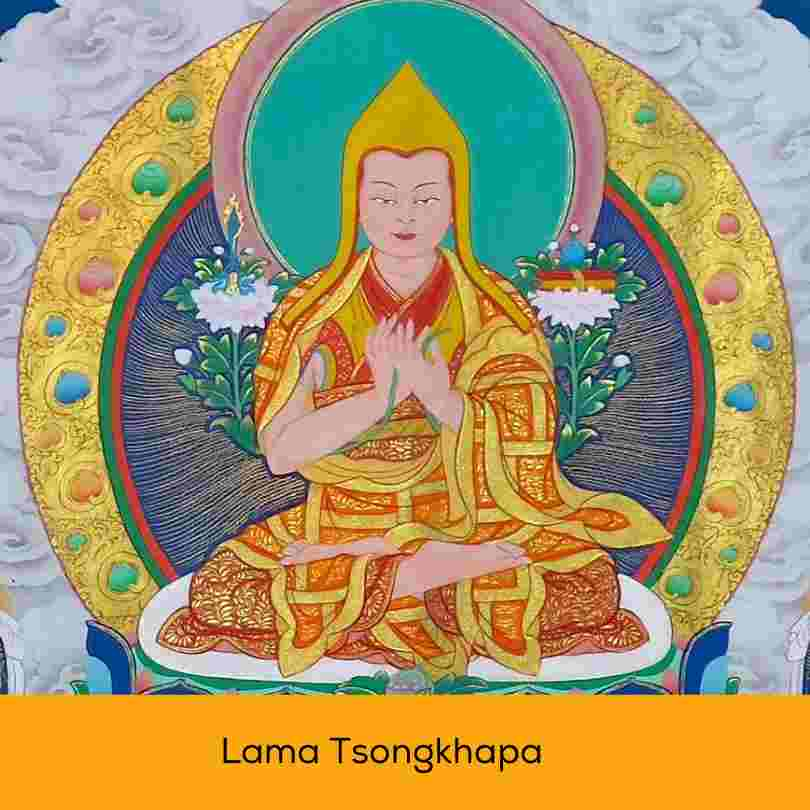
Lama Tsongkhapa, whose full name is Je Tsongkhapa Lobsang Drakpa, was a 14th-century Tibetan Buddhist monk, teacher, and philosopher. He is renowned for being the founder of the Gelug school of Tibetan Buddhism, also known as the “Yellow Hat” tradition. This tradition places a strong emphasis on the systematic study of Buddhist philosophy and ethics.
Lama Tsongkhapa’s teachings are considered to be a synthesis of various Buddhist traditions, combining elements from the Kadampa, Sakya, and Kagyu schools, among others. He emphasized the importance of studying Buddhist texts, logic, and reasoning in order to gain a deep and accurate understanding of the teachings.
One of Lama Tsongkhapa’s most significant contributions is his elaboration on the concept of the Middle Way, also known as Madhyamaka, which is a philosophical approach that seeks to transcend extreme views and find a balanced understanding of reality. He also emphasized the practice of ethics, compassion, and wisdom as essential components of the path to enlightenment.
Lama Tsongkhapa’s teachings have had a profound influence on Tibetan Buddhism, particularly within the Gelug school. His work, including texts on philosophy, meditation, and practice, continues to be studied and followed by practitioners to this day. Additionally, the Gaden Tripa , who belong to the Gelug tradition, consider themselves to be his spiritual heirs and have played important roles in spreading his teachings and guiding Tibetan Buddhism.
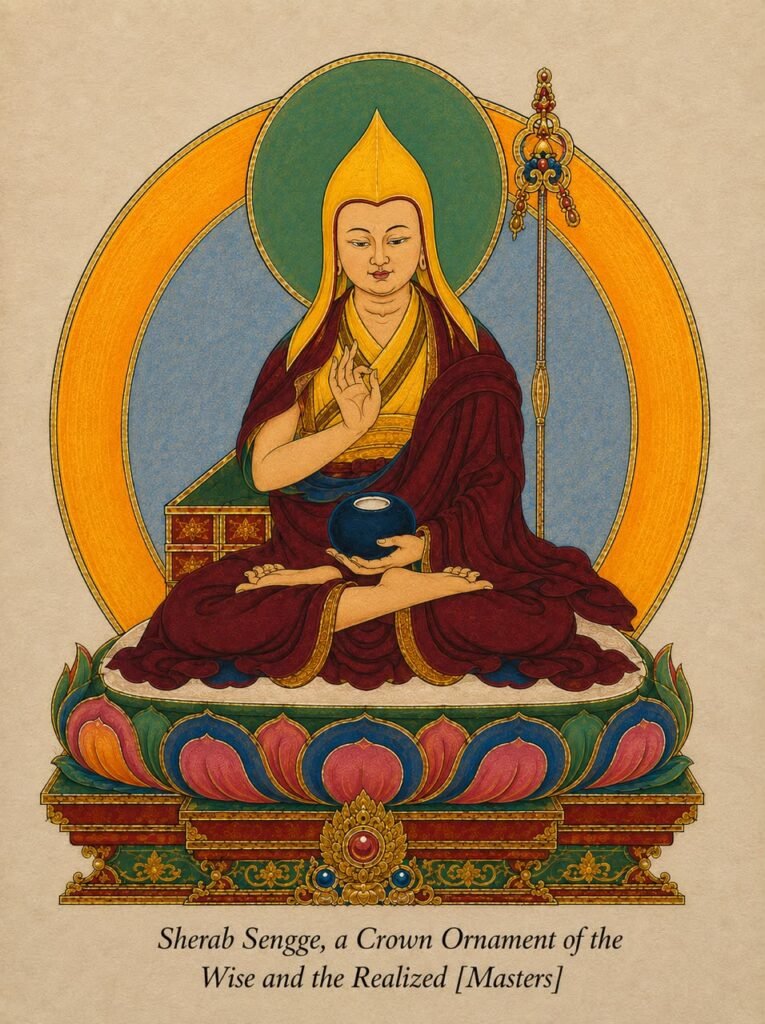
Jetsun Sherab Sengge, born in the year 1383 in Gurme, Tsang, was the son of Dampa Marpo and Choku Tashi. From an early age, he showed little interest in welcoming visitors to his home but displayed an early curiosity about religion.
At the age of ten, he entered Nartang Monastery, where Khenchen Drubpa Sherab ordained him with the name Sherab Sengge. He received transmissions and teachings from eminent figures like Sakya scholar Yaktruk Sanggye Pel, Shangpa Kunkhyen Sherab Pelzang, and Rongton Sheja Kunrik. Full ordination followed when he turned twenty, administered by Drubpa Sherab.
In 1410, he journeyed to U and met Tsongkhapa Lobzang Drakpa, from whom he received teachings on Vinaya and Abhidharma. Subsequently, he traveled with Tsongkhapa to Won Tashi Doka, where he studied logical reasoning, Nāgārjuna’s Mūlamadhyamakakārikā, and his commentary, as well as the Essence of Eloquence on scriptural hermeneutics.
At Ganden Monastery, Tsongkhapa imparted instructions, transmissions, and commentaries on various tantric teachings, including Chakrasaṃvara, Kālachakra, and Hevajra, and Sherab Sengge diligently mastered these tantras. Later, at Sangpu Monastery, he taught Chakrasaṃvara rituals to Gendun Drub, who would become known as the First Dalai Lama.
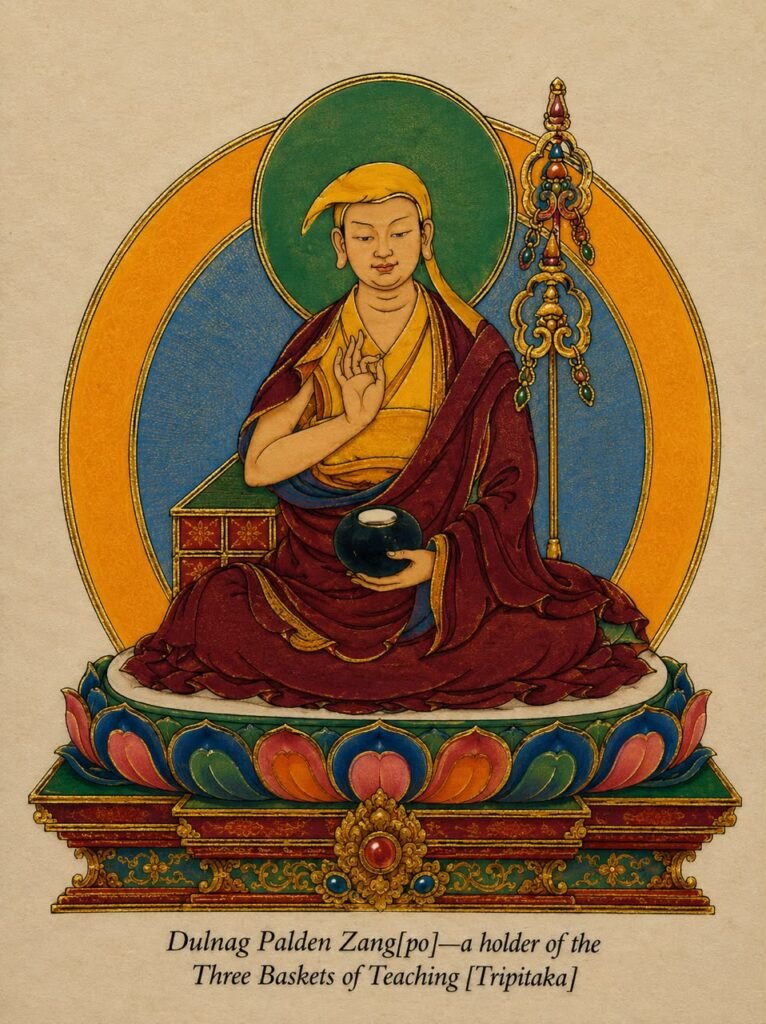
Dulnagpa Palden Zangpo, born in 1402 in the town of Tanag Dhar of Tsang Region, Tibet had a significant spiritual journey. He was a direct disciple of Jetsun Sherab Sengge, who was the founder of Gyume, also known as the Lower Tantric College. Importantly, Jetsun Sherab Sengge himself was a direct disciple of the renowned Je Tsongkhapa.
Dulnagpa Palden Zangpo’s spiritual journey began with his ordination at Narthang Monastery. Through his devoted practice, he achieved profound spiritual realizations. He became known for his ability to heal the sick through his prayers, particularly through the recitation of Je Tsongkhapa’s Migtsema prayer, which he enjoyed teaching to others. His devotion to this practice inspired him to compose the text “Hundreds of Deities of Tushita.”
At one point in his life, a local deity named Pehar was causing distress to the people of Se in Tsang, leading to unfortunate consequences, including deaths. Dulnagpa Palden Zangpo intervened using his spiritual powers and managed to pacify Pehar, instructing the deity not to harm those who recited the Migtsema prayer he had authored.
In accordance with Je Tsongkhapa’s wishes, Jetsun Sherab Sengge traveled throughout the Tsang region of Tibet, offering teachings. In the locality of Yagshilung, he imparted his wisdom and knowledge to Dulnagpa, and entrusted him with establishing a tantric college there. In fulfilment of that command, in 1432 Dulnagpa founded Segyu Monastery, also known as the Tantric College of Se District — the college Jetsun Sherab Sengge established by entrusting it to him, an institution dedicated to the study and practice of tantric teachings.
He passed away in 1473 at the age of 71, leaving behind a legacy of spiritual devotion and teachings that continue to inspire practitioners in the Tibetan Buddhist tradition.
Explore the rich history of the Segyu Lineage by subscribing to our YouTube channel! Dive into centuries-old traditions, profound teachings, and inspiring stories of the Segyu Monastery, the first tantric college of Gelugpa Lineage. Our channel offers exclusive content that delves into the spiritual legacy and cultural heritage of the Segyu masters, showcasing the rituals and wisdom passed down through generations. Whether you’re a practitioner or simply curious about Tibetan Buddhism, this channel offers a unique window into a vibrant tradition that continues to thrive today. Don’t miss out—join us and stay connected!