
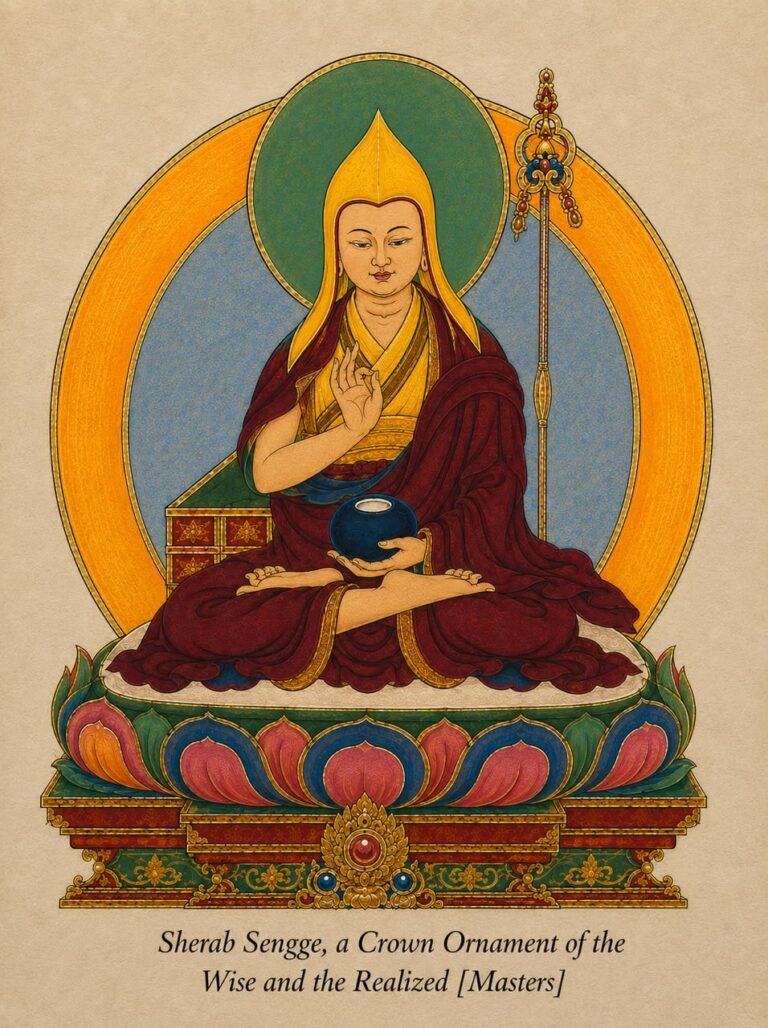
Jetsün Sherab Sengge (1383–1445) was one of the foremost disciples of Je Tsongkhapa, the great Dharma King and founder of the Gelug tradition. Born in the Se valley of Tsang, he trained at Narthang and then attended upon Tsongkhapa in Central Tibet, receiving the complete transmission of the Guhyasamāja, Cakrasaṃvara, and the other great tantras. When Tsongkhapa asked who among his disciples could uphold the explanatory tradition of the Guhyasamāja “just as it is,” Sherab Sengge alone rose and pledged to do so — and was enthroned as master of the Vajrayāna teaching, entrusted with Tsongkhapa’s own sacred image, texts, and ritual supports. Carrying that charge across Ü and Tsang, he established, through his disciple Dulnagpa Palden Zangpo, Segyu Gaden Phodrang and the glorious Gyümé (Lower Tantric College), securing an unbroken living lineage of tantric study and practice. From him descends Segyu Gaden Phodrang Monastery to this day. What follows is the full traditional biography (namthar), translated from the Tibetan.
The Biography of Jetsün Sherab Sengge, Sovereign of the Doctrine of the Segyu Lineage
Among the four great sons whose enlightened activity is as vast as space — the spiritual heirs who upheld the resolve and activity of the great being Mañjunātha, the Dharma King, the great Tsongkhapa — Dulnak Palden Zangpo too was a principal one who entered the working circle of this dharma college. Yet it was by the instruction of Jetsün Sherab Sengge that this community of holders of secret mantra (rig-ngak) was first laid down and inaugurated. Since the master of the complete teaching of both sūtra and mantra of this tradition is the Venerable Sherab Sengge, his life of liberation is set down here in brief as follows.
This great being was born in the land encircled all around by the white snow-ranges. Of the three provinces — Ü, Tsang, and Kham — he took birth in Tsang, in the district known as Lung-lak Gurma in the Se valley, as the son of his holy father Marpo and his mother Chöku Tashi.
At the age of fourteen he entered the gateway of the Dharma at Palden Narthang, the great Kadampa seat founded by Tumtön Lodrö Drak. There he received the vows of a novice monk (getsul) from Khenchen Drubpa Sherab, the fourteenth abbot of that seat and a lord of the five sciences. He then studied the Maitreya treatises, the Madhyamaka collection of reasoning, and other great scriptural works at the feet of the great scholar Sangye Pal.
At the age of twenty he received the fully ordained monk’s (gelong) vows, complete in all the bases of training, from Khenchen Drubpa Sherab. Then, drawn by faith toward the secret sites of the three doors of the great Conqueror Tsongkhapa together with his two foremost sons, he traveled to Ü. After completing his pilgrimage to the sacred objects of Lhasa, he proceeded to Ganden Namgyal Ling. There, the moment he beheld the golden face of the Dharma King, the great Tsongkhapa, an unfabricated recognition of him as an actual Buddha arose in his mind. From then on he attended upon him inseparably and received boundless cycles of the profound and vast teachings of sūtra and mantra.
In accordance with the advice of the guru Mañjunātha Tsongkhapa, he studied the four scriptural divisions of the Vinaya and the Abhidharma basket at the feet of Kyorlung Khenchen Samten Döndrub. While serving as part of the retinue when the ruler Drakpa Gyaltsen invited the great Tsongkhapa to Ön Tashi Dokha, and on countless other occasions, he received innumerable successive transmissions of the Dharma. Although it is said that earlier, having studied with certain Sakya masters, he had entered that tradition’s tenet system, later — by receiving the holy Dharma from the Second Conqueror’s two foremost sons and from Düldzin Drak[pa] Gyen and others — he upheld the pure tenets of the Gelug tradition.
In keeping with Tsongkhapa’s command, from the Conqueror’s son Zangkyongwa he received the four empowerments of the glorious Guhyasamāja maṇḍala together with the complete pith instructions. In particular, from the great guru Tsongkhapa himself he received the renowned transmission known as “The Four Commentaries Combined on the Guhyasamāja” — that is, Candrakīrti’s Pradīpoddyotana, the very essence of the ocean of tantra-classes, which comments on the root tantra of the father-tantra Guhyasamāja joined with its six explanatory tantras, combined with the four annotations of the great Lord Tsongkhapa himself: the running interlinear notes, the marginal-note summaries, and the critical analysis. He also received the Caryāsaṃgraha (the condensed practice of the Five Stages) composed by the noble father and son [Nāgārjuna and Āryadeva], and Tsongkhapa’s own Rim-nga Saldrön (Lamp Illuminating the Five Stages of Guhyasamāja completion), the Cakrasaṃvara tantra and its commentaries, Kālacakra, Hevajra, the Yamāntaka cycle, and the general classes of tantra. In particular, since Tsongkhapa bestowed upon this holy being many completion-stage instructions of Guhyasamāja that he gave to no other disciple, he came to abide as a great being supremely learned in the profound key points of the tantras.
In general, although among Tsongkhapa’s disciples — who appeared as if filling the earth from the sky — there came forth countless holy ones of inconceivable enlightened activity, the bodhisattva and great being upon whom fell the transmission of holding and propagating, in particular, the instructions of the father-tantra Guhyasamāja and the mother-tantra Cakrasaṃvara tantra-classes — having realized in his mind the profound Madhyamaka view and the stable meditative absorption of generation and completion, being blessed by his yidam deity, and having accomplished the power of bodhicitta to spread the Lord’s activity — was none other than this Jetsün Sherab Sengge. Foreseeing that the time had ripened to empower this holy one, among all his disciples, as master of the teaching of the Vajrayāna, in the female-earth-pig year of the seventh sexagenary cycle, 1419, the great Lord Tsongkhapa first gave instruction at Sera Chöding that an exposition-and-study center for the tantras must be established. Jamchen Chöje, in accordance with the Lord’s command, offered the founding basis for its accomplishment. To a great gathering of learned disciples assembled there, the great Lord Tsongkhapa graciously bestowed daily teaching-sessions, expounding from the very beginning of the root tantras of both Guhyasamāja and Cakrasaṃvara.
At that time the Dharma King, the great Tsongkhapa, took into his hands the volume of “The Four Commentaries Combined on the Guhyasamāja” and, twice over, posed the question: “This tradition of explaining the glorious Guhyasamāja tantra — who is there among you scholars able to uphold and propagate it just as it is?” From among that ocean-like gathering of many learned disciples present, this great being Jetsün Sherab Sengge alone rose up. Prostrating, he made his solemn pledge, saying, “I shall accomplish it in accordance with the Lord’s own intention.”
At this the great Lord rejoiced greatly and bestowed upon him as gifts a special golden image of Guhyasamāja, a kapāla filled with inner-offering, the volume of “The Four Commentaries Combined on the Guhyasamāja,” a terma mask of the oath-bound Dharma King (Dharmarāja), a ritual-dance costume, and a club and lasso — thereby enthroning this great being as master of the teaching of the secret-mantra Vajrayāna. The master and his circle of disciples performed the sojong (purification rite) there as well.
Then the great Lord said to him: “It would be good for you to go to the Tsang region; go there and carry out the exposition and study of the tantras. In a place resembling an overturned bell, a yogin who has been cared for over many lifetimes by Yamāntaka will become your disciple and act as your companion. And in a place like a rākṣasī-mountain lying supine on her back, a yakṣiṇī will act as your benefactor — this you shall come to know.” Thus he gave his prophecy.
Having accomplished these things, he taught at the college known as Sangphu Tongmön Dratsang — later renowned as Nam Rab Dakpo Dratsang. Entrusting the college to Je Gendün Drub, he returned to Tsang in 1426, the fire-horse year of the seventh sexagenary cycle. With the fortress-governor Sangye Kyab as his benefactor, he carried out exposition and study for a time at Narthang, Jangchen, Tanak and elsewhere; the assemblies of disciples who gathered there in great numbers later became the foundation upon which Je Gendün Drub established Tashilhunpo.
Then at Riwo Ganden he completed his studies of the Kālacakra and the Bhairava (Yamāntaka) cycle with its branches at the feet of Khedrub Je. Returning again to Narthang, Jangchen and other places, he carried out various works for the doctrine. Later he was invited by Hor Paljor Zangpo of Chongye Taktse, governor of the fortress later known as Shigatse Samdrubtse; this lord offered Je [Sherab Sengge] the Samdrub Drakmar Chöde, which he accepted as his own.
While this Lord was unwell in the Desal residence at Samtse, the lord of yogins Zangpo Gyaltsen requested [permission] and performed the great Mahākāla torma rite, whereby the signs of his illness were pacified without remainder. Receiving from Gyaltsab and Khedrub — the two who, foremost among the [Conqueror’s] sons, were then residing at Nenying Chöde — whatever fortunate portions of the holy Dharma were fitting, he proceeded once more to Samdrubtse.
While his meditative practice was flourishing there, the memory was rekindled in him of how, formerly, in the presence of the Dharma King, the great Tsongkhapa, he had himself offered the solemn pledge to spread the teaching of the tantras. Accordingly, at the invitation of Situ Sönam Pal and the lady Shākya Pal, he proceeded to Lhünpotse. There the benefactor couple, together with that monastery’s teacher Phagö Yönten Gyatso, and many scholars of Ü, attended upon him. At that place he newly established the Guhyasamāja sādhana-maṇḍala in the unerring practice-tradition of the great Conqueror Tsongkhapa, together with its exposition and study; and in connection with this he installed the terma mask of the oath-bound Dharma King, the club, and the lasso as sacred supports of the Lhünpotse monastery. The Dharma-lord Phagö Yönten Gyatso in turn composed works such as the Drönsal Namnge, a commentary on the Guhyasamāja tantra, and took up the genuine task of furthering the tradition of explaining the tantras. He is held to be the very Yamāntaka-yogin foretold by the guru Tsongkhapa.
Then he settled at Sengetse, where, with the lady Shākya Pal as patron, he likewise established the sādhana-maṇḍala, its practice-rites, and so forth. The prophesied [patroness] is also held to be this same one.
Not long after, in accord with his enlightened resolve, the bodhisattva and vinaya-holder [Dulnak Palden Zangpo] took the accomplishment of the command of the great spiritual friend — the root of all happiness and goodness — as the very heart of his meditative practice. The favorable conditions and auspicious circumstances for the activity of the three wheels to rise ever higher came genuinely together, and, through his disciple Dulnagpa Palden Zangpo, whom he sent to the valley of Yakshi, he established Segyu Gaden Phodrang. There, the volume of the Lord’s “Four Commentaries Combined on the Guhyasamāja” was installed as the inner sacred support, and its exposition and study were established. Having furthered this seat together with its supports and dependents, he finally entrusted the original main seat to Dulnak Palden Zangpo and himself proceeded to Ganden Namgyal Ling.
There he founded the glorious Gyümé (Lower Tantric College), bound up with the commentarial exposition and study of the tantras. He then received various teachings of the lower tantra-classes from Khenchen Drakpa Gyaltsen. He held for some years the abbatial seat of Rikhü Chöde, which had been offered by Tanak Gejong Karpo. He received many streams of Dharma transmission from the omniscient Sherab Palzang of Shang-do Riwo Gephel, father and son. Then, entrusting Rikhü Chöde to Je Gendün Drub, he proceeded in stages to Ganden. There he gave commentarial exposition and study of the tantras to the many scholars of Ü and Tsang who gathered, and so caused the college of the glorious Gyümé to flourish further. After that he was invited to Tölung by the doctrine’s benefactor, the Neu lord Namkha Paljor, and bestowed the exposition of the Guhyasamāja upon the spiritual friends there.
From this time onward, the master and disciples spread the Dharma, conferring tantric instruction, and he gave in succession the many assemblies of the Second Conqueror’s oral-instruction pith teachings. Then, entrusting the teaching of the exposition and study of the tantras and their commentaries to the great tantrika Jinpa Palwa, and bestowing upon the college a blessed reflected image of Guhyasamāja and other [supports], he said, as the disciples to be trained in this very life were nearly complete: “Bring these texts of mine to the place of Gendün Drub.” Then the master and all his disciples proceeded to Ganden Namgyal Ling. There, amid the practice of profound meditative yoga and an unbroken stream of pure visionary experience, in the female-wood-ox year of the seventh sexagenary cycle — that is, 1445 — on the twenty-eighth day of the waning moon of the intercalary fifth month, the display of his form-body dissolved into the dharmadhātu and he passed into nirvāṇa. His remains were offered to the fire; his skull remained whole and undamaged, and many relics appeared. Je Gendün Drub had them brought forth and installed them as the inner relic-contents of the principal image, the Lord of Sages (Munīndra), in the great temple of Tashilhunpo.
The voice-born disciples of this great being, Jetsün Sherab Sengge, were: Je Gendün Drub; Phagö Yönten Gyatso; Dorjechang Jinpa Pal; Rabjampa Mönlam Pal; Düldzin Lodrö Bepa; Düldzin Palden Zangpo; Gyüpa Drak Zangpa; the Dakpo Tashi Namgyal brothers; Panchen Zangpo Tashi; Drakpa Samdrub; Chöje Dagyalpa; the scholar Rinchen Shākya — and besides these, many other learned and accomplished great beings came forth.