
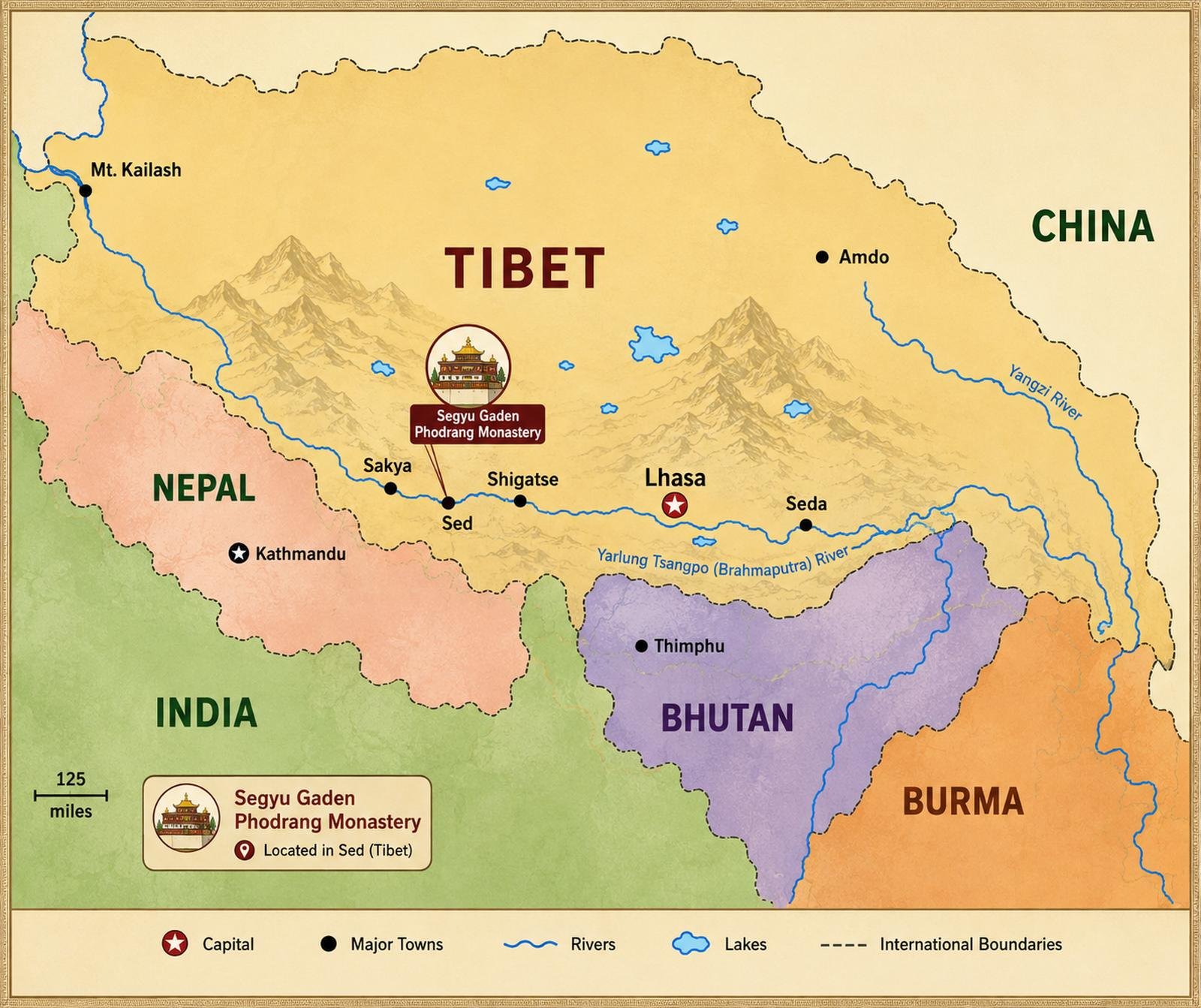
Segyu Gaden Phodrang is the oldest of the Gelug tantric monasteries — founded in Tsang before 1432, a year ahead of Gyümé and forty-odd years ahead of Gyütö. Its history begins with an instruction from Je Tsongkhapa and a prediction he left unfinished.
The account here follows the monastery’s own published history, Zongtse Tulku Jampa Thupten’s History of Segyu Gaden Phodrang Monastery (1432–1959).
Jetsün Sherab Sengge
Jetsün Sherab Sengge (1383–1473) is counted among the four great spiritual sons of Je Tsongkhapa. He was born at Gurma, in the Sed district of Tsang, to Dampa Marpo and Chöskyi Tashi, and received his ordination from the abbot Drupa Sherab.
Drawn by devotion to Tsongkhapa, he travelled to Central Tibet and entered Gaden Monastery, where he became an attendant and disciple. There he received the four empowerments of Glorious Kalachakra and the tantric transmissions that would define his life’s work — above all the teachings on Guhyasamāja.
In 1419, at Sera Chöding, Tsongkhapa spoke of his wish to see a seat established for the study and teaching of Tantra. It was Sherab Sengge who was entrusted with carrying that wish into effect. Read his full life.
The journey to Tsang
Sherab Sengge first taught at the monastery later known as Namrab Dagpo Datsang. In 1426 he handed it over to Je Gedun Drup — the master later recognised as the First Dalai Lama — and set out for Tsang.
Sponsored by the district magistrate Zongpon Sangye Kyab, he taught at Narthang, Jangchen and Tanag, gathering disciples as he went. Among them was the man who would become his Dharma Regent: Dulnagpa Palden Zangpo, born at Tanag Dhar in 1402.
“Where the yak dies, the horse dances”
Tsongkhapa had given Sherab Sengge a prediction and then stopped short, telling him that he would know the rest himself. The monastery’s records place its fulfilment in an exchange over tea.
Seated in the row, Sherab Sengge asked Dulnagpa his birth-year sign. Dulnagpa answered that it was the Horse. Sherab Sengge took this as auspicious, citing the worldly saying that where a yak dies, a horse dances — and sent him to the valley of Yakshi to establish the study and teaching of Tantra there.
He offered Dulnagpa Je Rinpoche’s hat and robe. Dulnagpa declined them, saying they befitted Je Gedun Drup, and asked instead for the Four-in-One Commentary on Guhyasamāja. He was given the commentary in its traditional binding, together with Je Rinpoche’s alms bowl.
Not knowing the region, Dulnagpa asked directions as he travelled. At the mouth of the valley a man told him he knew no such place — but that the ravine above was called Yakshi Nang. There he built a scripture-house against the rock and practised the generation and completion stages of Vajrabhairava.
The founding
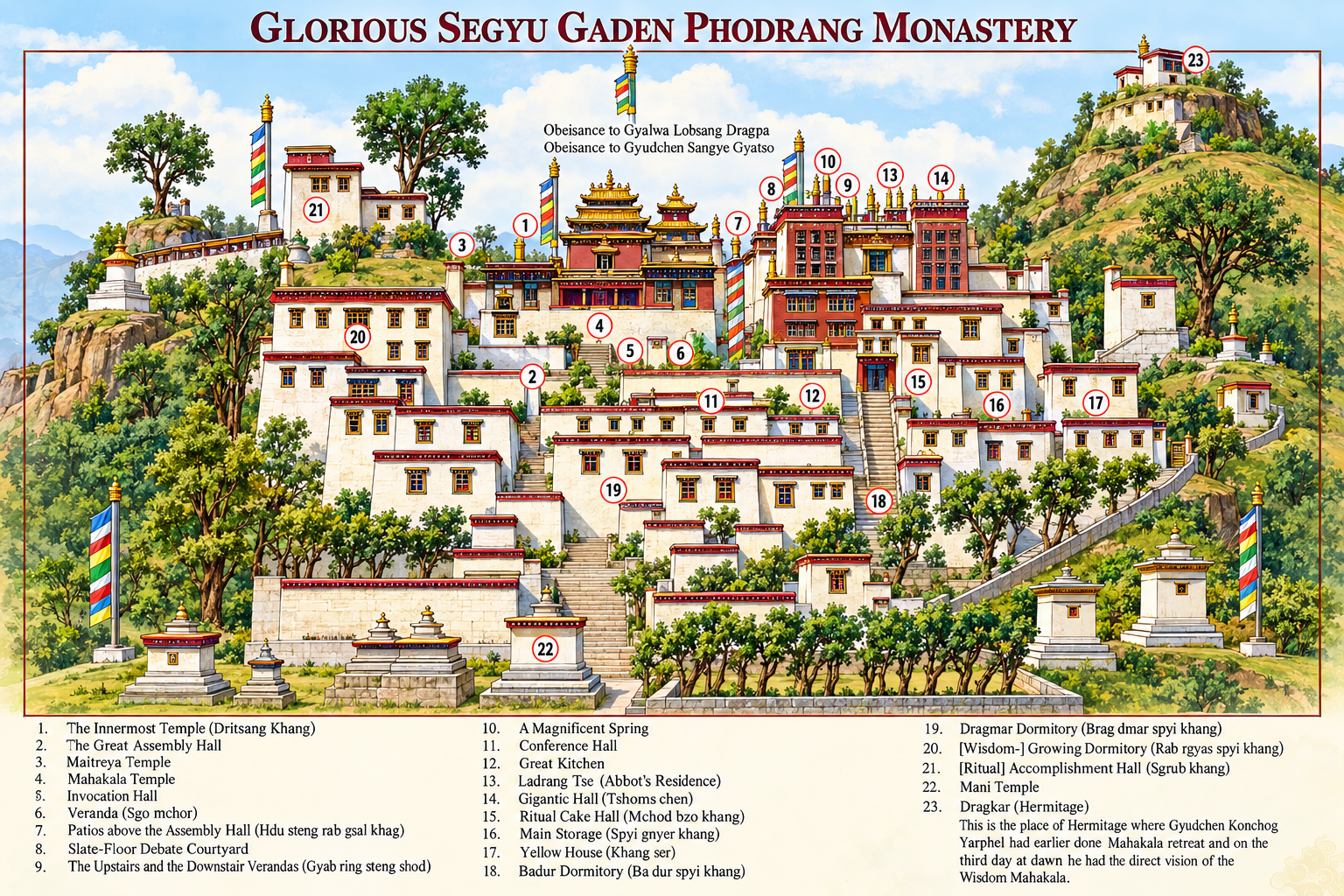
As disciples gathered, Dulnagpa saw the need for a monastic hall and quarters, so that a proper community of study and practice could be established. The chief patron was Se Rinchen Tsewa, whose generosity the records single out, alongside many other benefactors.
On an auspicious day the preliminary rites were performed and the foundation laid. A monastic hall was built, and the buildings of Segyu Gaden Phodrang were completed before the Water-Bird year — 1432.
Segyu first, then Gyümé
It was here that Sherab Sengge and Dulnagpa established the teaching of Guhyasamāja, Heruka and Yamantaka in Tsongkhapa’s tradition. Only once that was flourishing did Sherab Sengge return to Central Tibet, where in the Water-Ox year — 1433 — he founded Gyümé, the Lower Tantric College.
Gyütö, the Upper Tantric College, followed in 1474, founded by Gyuchen Kunga Dondrub, himself a disciple of Sherab Sengge. All three institutions therefore descend from one master, and Segyu is the eldest of them.
The line of masters
Sherab Sengge entrusted the monastery to Dulnagpa, who in turn passed it on, and the succession of abbots continued unbroken from there.
Within that succession the records identify a close lineage (nye brgyud) of ten realised masters who arose from Segyu itself and held its secret tantric instructions: Jetsün Sherab Sengge, followed by the nine Gyudchen — from Dulnagpa Palden Zangpo to Könchog Yarphel, the ninth, whose transmission reached the First Jamyang Zhepa and through him the tantric college of Labrang in 1719.
Exile and re-establishment
The monastery continued at Sed until 1959. After the events of that year part of the community left Tibet, and in 1986 Segyu Gaden Phodrang was re-established at Tinchuli, near the Boudhanath Stupa in Kathmandu.
It stands there today under its present abbot, with around 130 young monks in training. The transmissions the founders established — Guhyasamāja, Heruka and Yamantaka — remain the heart of the Segyu lineage, and the protector practices of the Great Kangso are still performed on the annual calendar.
Sources
- Zongtse Tulku Jampa Thupten (Champa Thubten Zongtse), The History of Segyu Gaden Phodrang Monastery (1432–1959), trans. Tenzin Dorjee (Delhi: Aditya Prakashan, 1995), chapters 1–3.
- Treasury of Lives — Segyu Dratsang
- Alexander Berzin, ‘Gelug Monasteries: Gyume and Gyuto’
Support the monastery
Nearly six centuries on, the same transmissions are held here by 130 young monks.
- Sponsor a monk — support a young monk’s education, food and medical care.
- Sponsor a puja — support the ritual cycle that keeps these transmissions in daily use.
- Make an offering — support the monastery wherever the need is greatest.